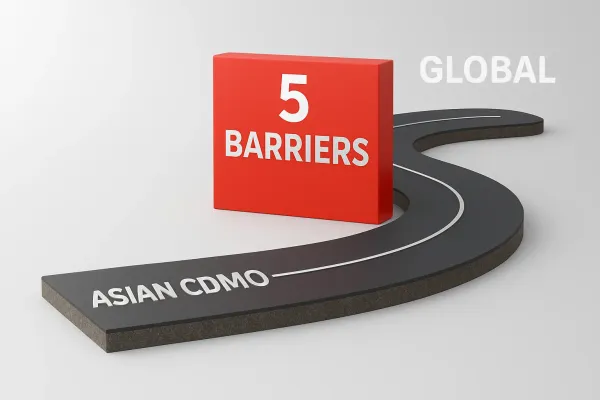
Practical strategies for Regional CDMOs to accelerate to global market and overcome Western biotech hesitation. Learn how specialization, GMP certifications, strategic partnerships, and industry networking can help small to mid-sized CDMOs become trusted partners in US, EU, and Japanese markets

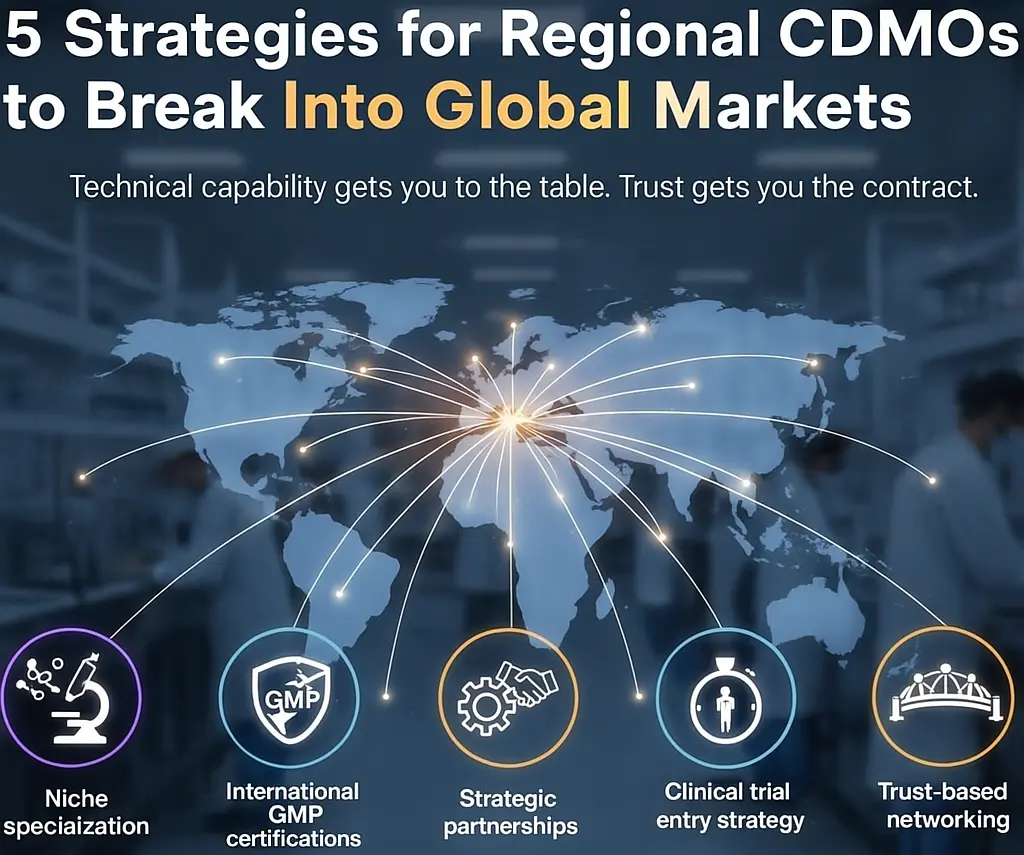
With limited resources, small to mid-sized CDMOs should prioritize specialization so that the market can clearly recognize their core capabilities. Instead of trying to offer “everything to everyone”, focus your resources on a domain where your team has unique expertise. This prevents resource dispersion that leads to being “jack of all trades, master of none.”
Each of the following drug types requires specialized techniques and corresponding production equipment:
Assess current and potential blockbuster drug areas, positioning yourself ahead of market trends
If financially supported, acquisitions can be a rapid expansion option—Taiwan’s Bora Pharmaceuticals is a good example.
The pharmaceutical industry differs fundamentally from IT: while semiconductor products meeting ISO standards can be sold globally, drug manufacturing requires country-by-country certification. The actual operational model works as follows:
Note: Depending on drug type, EU member states can use EMA centralized approval for distribution across member nations.
In some countries, local regulatory authorities lacking sufficient pharmaceutical review capabilities and manpower may accept drugs already approved in the US, EU (and sometimes Japan), simplifying the review process for these drugs.
Therefore, most clients prioritize CDMOs that can assist with US, EU, and Japanese certification. Obtaining GMP certification from mainstream pharmaceutical markets greatly supports CDMOs to break into global markets.
Strategic cooperation with appropriate partners accelerates global expansion.
If your goal is to enter the US, EU, or Japan market , consider partnering with local CDMOs that already have strong market presence and client relationships.
Focusing on promising drug development companies or biotech startups in target markets can accumulate specific domain expertise and experience.
If collaboration goes well, the CDMO can grow alongside the startup.
Considering that startups typically have tighter budgets,
CDMOs can consider splitting contracts into multiple milestones for payment, easing the startup’s cash burn rate:
If startups offer equity in lieu of partial manufacturing fees, it can slow their cash burn rate. Additionally, when the startup succeeds, the CDMO benefits from stock appreciation. Sharing interests through equity strengthens mutual motivation.
However, if a CDMO holds startup equity, the following risks should be considered:
As a member of the PIC/S GMP alliance, member country enjoys mutual recognition advantages with other member countries.
Certain countries recognize GMP certificates from other PIC/S member countries
Practical Impact: Generally, arranging inspections (including personnel arrangement, scheduling, on-site audits, deficiency corrections, and completion of certification) takes about a year. If inspections can be simplified or be waived, it will greatly help faster drug launch in those markets.
Opportunities for PIC/S member CDMOs: For countries that mutually recognize PIC/S GMP certification, CDMOs have clear advantages in contract manufacturing cooperation.
Networking isn’t just about who you know, but what value you create for each other.
At this point, I must emphasize the importance of network building. But I want to stress that it’s not simply about “knowing who’s who,” but rather cultivating your professional value. Core principles for cultivating professional value include:
Technical capability gets you to the table. Trust gets you the contract.
Trust is the keystone in business cooperation.
I once witnessed a case: an Asian regional CDMO founder and a US startup founder were former colleagues who knew each other well and understood each other’s work styles. When the US startup prepared Phase I clinical trial drug manufacturing, they unhesitatingly commissioned this Asian regional CDMO.
Just like that? Why?
Because of the trust between the founders. They knew that difficulties would inevitably arise during drug development and manufacturing, but both parties knew these challenges would be faced honestly and solved proactively, rather than concealed.
This kind of trust is the most valuable asset in business cooperation.
The world is large, but circles are small—so please care your reputation.
If you’re considering globalization strategies for your regional CDMOs, consider this checklist:
The globalization path for regional CDMOs is full of challenges, but opportunities exist. Through niche positioning, compliance-first approach, strategic cooperation, precise market development, and building trust relationships, small to mid-sized CDMOs can find their place on the globalization stage.
Globalization isn’t achieved overnight—it requires long-term cultivation. Choose the right strategy, insist on quality, build trust, and your CDMO can become a trusted partner for global clients.
Extended Reading:
Why Asian CDMOs Struggle with Globalization: 5 Key Structural Barriers Explained
 ShaoChi CHENG
Feel free to leave comments and connect me by Email or LinkedIn to share your experiences or challenges you’ve encountered in the business globalization!
Feel free to sign up for our newsletter!