
Discover how GLP-1 drug revolutionized diabetes and weight-loss treatment. Learn the breakthrough discovery from Gila monster venom, and the evolution of marketed drugs from Exenatide to Semaglutide and Tirzepatide. Understand the science behind these game-changing medications.

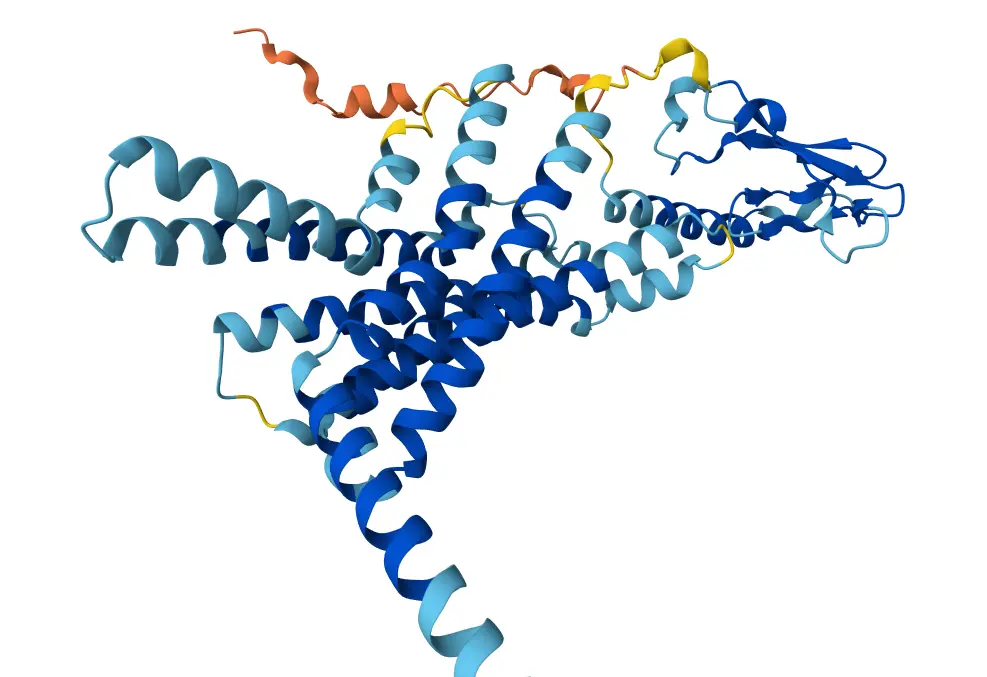
What is GLP-1 drug? GLP-1 is glucagon-like peptide-1, which is one of the body’s primary incretin hormones. It is secreted by the distal ileum and part of the colon in response to food intake. GLP-1 stimulates the secretion of insulin and somatostatin, while inhibiting the release of glucagon. It helps lower blood glucose levels, aids carbohydrate absorption, and maintains glucose homeostasis in the body.
The secretion and action of GLP-1 are dependent on blood glucose levels; it’s the reason why GLP-1 rarely causes hypoglycemia – a common side effect of some other diabetes medications. Additionally, GLP-1 slows gastric emptying and prolongs the feeling of fullness, which helps suppress appetite and supports weight management. Because of these effects, GLP-1 drugs are also used for obesity treatment.
However, endogenous (naturally occurring) GLP-1 rapidly degrades in the body by an enzyme called dipeptidyl peptidase-4 (DPP-4), converting it into an inactive metabolite. This short half-life limits its therapeutic effect and make the body in homeostasis.
There are currently two main pharmaceutical strategies to utilize GLP-1 for diabetes treatment:
GLP-1 stimulates GLP-1 receptor and glucagon receptor on pancreatic islet cells, induces intracellular signal transduction pathways, promotes the secretion of insulin and somatostatin, and inhibits the release of glucagon. These actions help lower blood glucose levels, support carbohydrate absorption, and maintain glucose homeostasis in the body.
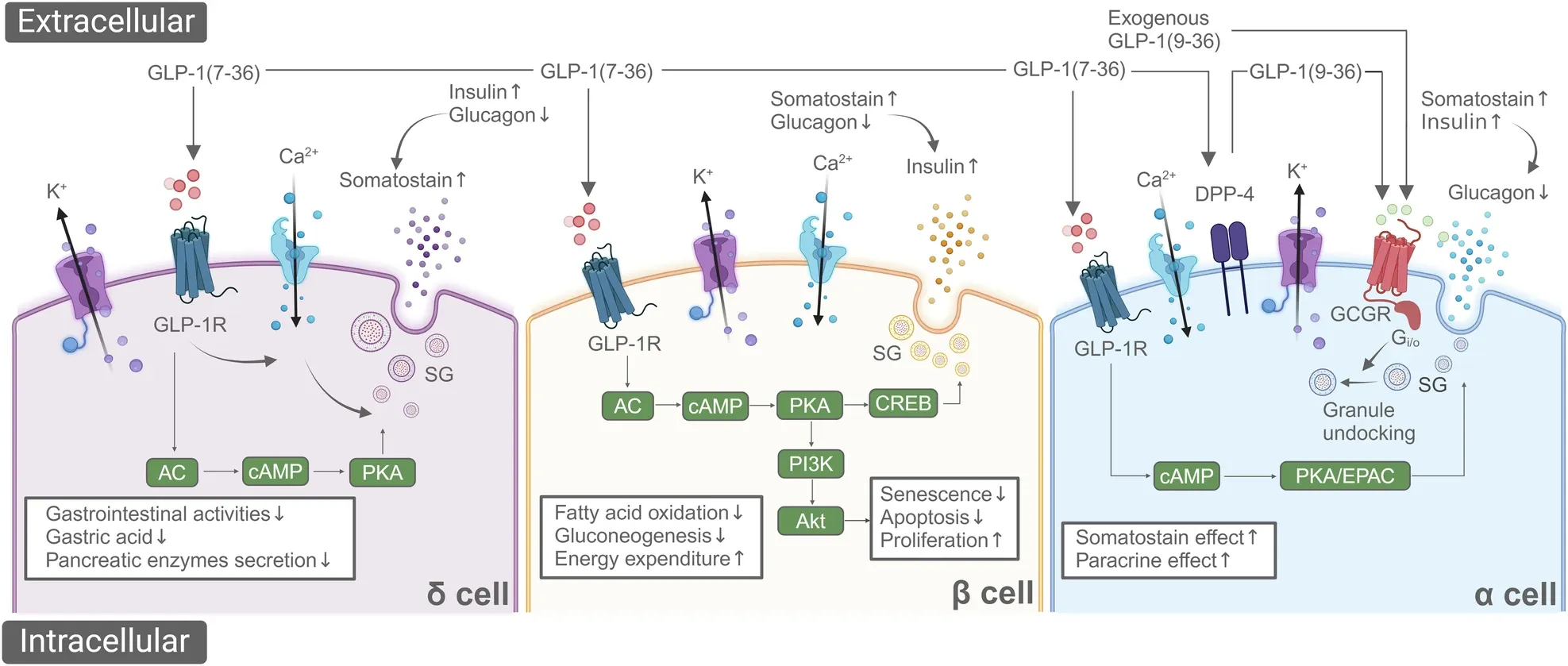
reference: https://www.nature.com/articles/s41392-024-01931-z
GLP-1 is a hormone secreted by the distal ileum and part of the colon in response to food intake. Hormones are internal chemical messengers that trigger cellular responses, so they typically have short half-lives. Once secreted, they are quickly deactivated – either automatically or by specific enzymes – to maintain the body’s internal balance (homeostasis).
However, if we want to use GLP-1 as a therapeutic drug, the short half-lives becomes a challenge. To take a compound into a drug, we need to consider several other issues like drug manufacturing, storage stability, and pharmacokinetics including absorption, distribution, metabolism, and excretion. Therefore, instability and short half-live of GLP-1 would limit its application to be a drug.
Fortunately, nature give us solution! Please allow me to show you an ugly cute venomous lizard, Gila monster, which is native to America and its venom give us solution. Scientists isolate a peptide called Exendin-4 from Gila monster’s venom. Exendin-4 has a structure very similar to human GLP-1 but there is one key difference. It is resistant to degradation by the DPP-4 enzyme, and this discovery gives crucial hints for scientists to improve stability for GLP-1.
Eventually, Exenatide, a synthetic form of Exendin-4, was developed as a GLP-1 receptor agonist drug. It was commercialized under two formulations: Byetta (short-acting) and Bydureon (long-acting).
The link below leads to National Geography which introduce Gila monster. You can click to learn more.

reference: https://kids.nationalgeographic.com/animals/reptiles/facts/gila-monster
There are several GLP-1 drugs launch to the market. The earliest GLP-1 drug is Exenatide; after that pharmaceutical companies launch new GLP-1 drug every 4 to 5 years. In the beginning, GLP-1 drug is used to treat type 2 diabetes, but big pharma expand its treatment to weight-loss because of its appetite-suppressing effects and expect its potential benefit in weight loss market.
The development of GLP-1 drug keeps going. Semaglutide is GLP-1 drug which has side chain and it can sustain the stability of compound and it needs injection once a week. Tirzepatide is another GLP-1 drug, which is not only a GLP-1 receptor agonist but also targets glucose-dependent insulinotropic polypeptide (GIP), making it a dual agonist. Big pharmaceutical companies keep to improve the compound and hope to win the competition.
Here is a list of representative GLP-1 drugs and their launch years: