
CAR-T therapy redefined what a drug could be. By engineering immune cells into living medicines, CAR-T opened a new era of cell therapy. Here explains how CAR-T works, designs and drives innovation, understanding the science and its greatest challenges.


Twenty years ago, when I was still a undergraduate student, I read a popular science book called Dr. Folkman's War: Angiogenesis and the Struggle to Defeat Cancer. It was the first time I realized that some scientists were pursuing a completely different strategy for treating cancer. Instead of designing new drug molecules to kill cancer cells directly, they were exploring how the human immune system itself could become the treatment.
At the time, it sounded more like a vision of the future than a practical therapy.
A decade ago, however, the successful commercialization of CAR-T therapy turned that vision into reality. It marked a major milestone in cancer immunotherapy and demonstrated that engineering a patient's own immune cells could become a viable treatment for cancer.
There are already many excellent scientific reviews explaining the mechanism behind CAR-T therapy. Rather than diving into complex signaling pathways, I'd like to focuses on the core concepts through a series of common questions. My goal is to help you quickly build a solid understanding of how CAR-T works before exploring its scientific and commercial implications.
CAR-T (Chimeric Antigen Receptor T-cell Therapy) is a form of cancer immunotherapy and one of the most successful technologies in the field of cell therapy.
Cell therapy includes several different approaches, such as TCR-T, TIL therapy, and NK cell therapy...etc. Among them, CAR-T is currently the most clinically advanced and commercially established.
Unlike conventional small-molecule drugs or monoclonal antibodies, CAR-T therapy begins by collecting a patient's own T cells. These cells are genetically engineered to recognize cancer cells before being expanded in the GMP facility and infused back into the patient.
Because the therapy consists of living immune cells rather than chemical compounds, CAR-T is often described as a living drug.
This is one of the biggest differences between CAR-T and traditional medicines. Conventional drugs gradually decline in concentration after administration. CAR-T cells, however, remain alive inside the body. They can proliferate, recognize cancer cells, destroy them, and in some patients even develop into long-lived memory T cells that persist for months or years.
A simple way to think about CAR-T is to imagine installing an entirely new navigation system into the body's immune cells. Normally, T cells may fail to recognize cancer cells effectively. CAR equips them with the ability to actively locate and eliminate their targets.
If you'd like to explore the scientific details further, these resources provide excellent introductions:
Most CAR-T therapies currently on the market are autologous CAR-T therapies, meaning they use the patient's own T cells. This manufacturing model is often described as "One Patient, One Batch"—every patient requires a unique cell product manufactured exclusively for them.
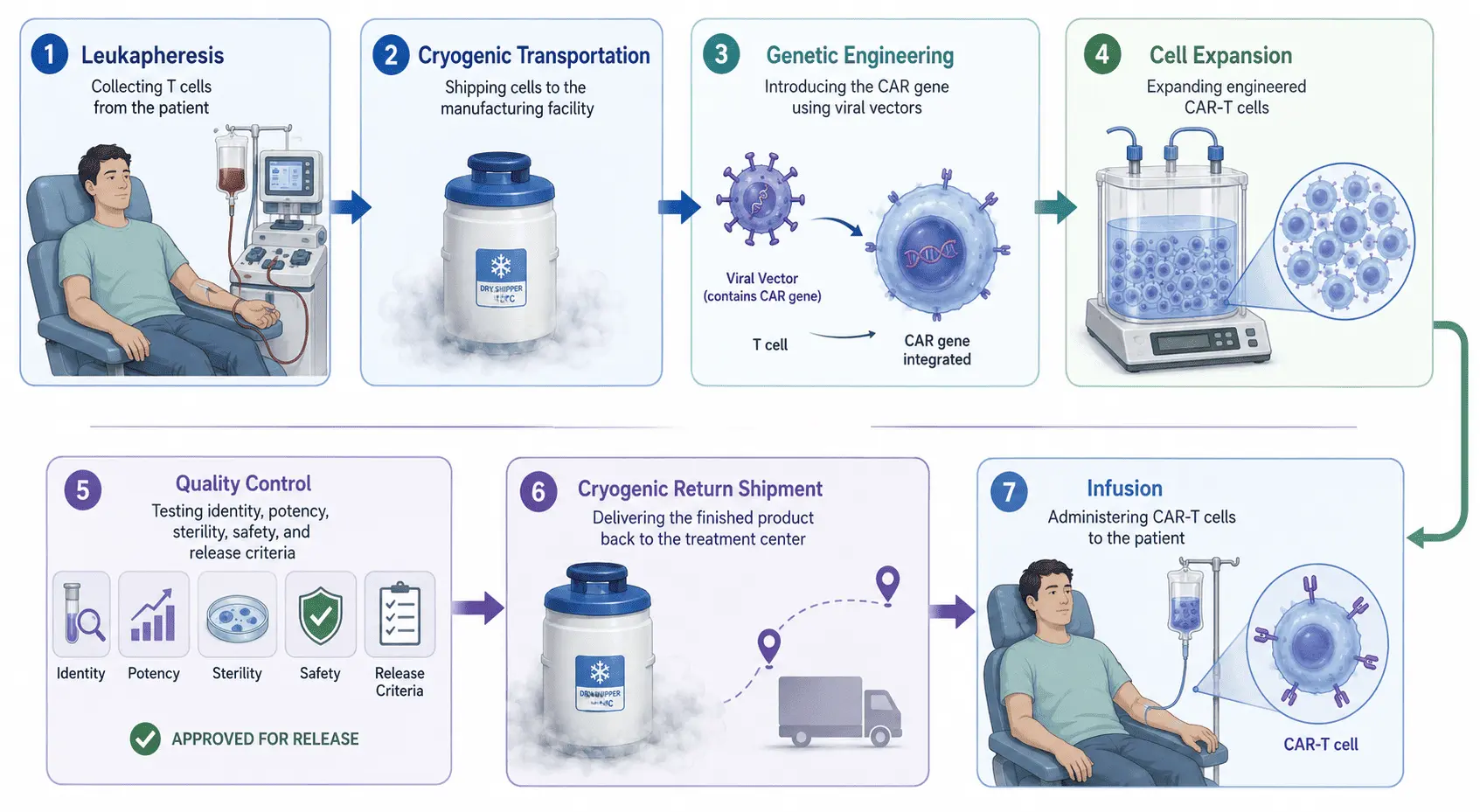
The overall treatment process typically consists of seven steps:
Because every batch belongs to a single patient, the manufacturing process is highly individualized. Unlike conventional pharmaceuticals that can be produced in large batches, autologous CAR-T therapy requires a dedicated manufacturing run for every patient.
This is one of the main reasons why CAR-T remains one of the most complex and expensive cell therapies in the world.
The key to CAR-T therapy lies in the Chimeric Antigen Receptor (CAR) displayed on the surface of each engineered T cell.
You can think of the CAR as a highly specialized sensor—or more simply, the navigation system—that enables a T cell to recognize a specific target on the surface of a cancer cell.
These targets are known as antigens, and different cancers express different main antigens. As a result, CAR designs vary depending on the disease being treated.
To date, CAR-T therapy has achieved its greatest success in blood cancer targeting antigens includes:
Researchers are now extending CAR-T into solid tumors, with targets such as:
An ideal CAR-T target should have one important characteristic: it should be highly expressed on cancer cells while being minimally expressed on normal tissues.
This selectivity helps reduce damage to healthy cells (side effects). In reality, however, finding such an ideal target is extremely difficult.
Most tumor-associated antigens are not truly cancer-specific. They are often present at low levels on normal tissues and become highly overexpressed in cancer cells. As a result, CAR-T cells may also attack healthy cells that express the same antigen, leading to treatment-related toxicities.
Strictly speaking, this phenomenon is known as on-target, off-tumor toxicity—the CAR recognizes the intended antigen, but that antigen is not exclusive to tumor cells.
For this reason, identifying safer and more tumor-specific targets remains one of the challenges in CAR-T research.
Yes—and this is one of the most important sources of intellectual property in the CAR-T industry.
Many companies develop CD19 CAR-T therapies, but the real differentiation is not the CD19 target itself. Instead, it lies in how the CAR is designed.
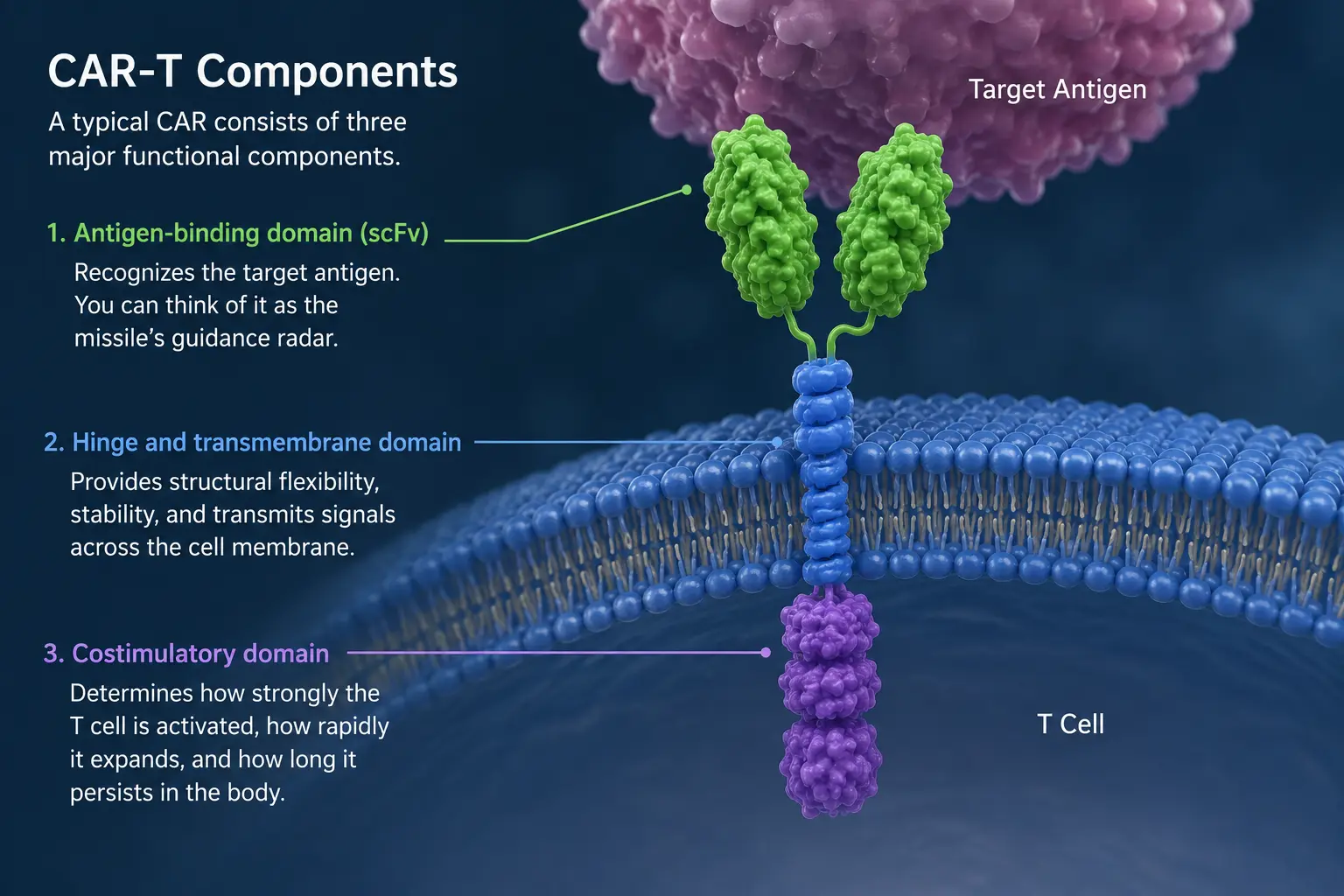
A typical CAR consists of three major functional components:
While companies continue to develop new antigen-binding domains, the costimulatory domain is also a major point of differentiation.
For example:
Although both therapies target CD19, they differ in T-cell expansion kinetics, persistence, efficacy, and safety profiles. These design choices contribute to meaningful clinical differences between products.
This is one of the most common misconceptions people have when they first learn about CAR-T therapy.
CD19 is a naturally occurring antigen found on human B cells. Because it is part of the human body, no company owns CD19 or can patent it.
So what exactly are CAR-T companies competing on? The answer lies in everything built around the target, including:
As a result, two companies may both develop CD19 CAR-T therapies, yet each must design its own CAR construct. These proprietary designs are protected by patents and represent one of the industry's most valuable intellectual property assets.
A useful analogy is a missile system. The antigen is the common target; the CAR is the guidance system designed by each company.
Everyone aims at the same target, but the guidance algorithm, flight performance, and accuracy can be entirely different.
This is why CAR design—not simply target selection—has become one of the primary competitive advantages in CAR-T development.
The industry's focus is gradually shifting. In the early years, discovering new target antigens was the primary goal. Today, many companies are asking a different question:
How can we build a better CAR-T therapy against targets we already know?
As a result, competition is increasingly centered on improving the overall performance of the therapy rather than simply identifying another antigen. Key areas of innovation include:
Another important trend is the development of dual-target and multi-target CAR-T therapies.
One reason patients relapse is antigen escape, where cancer cells stop expressing the antigen being targeted. To overcome this problem, some next-generation CAR-T therapies are engineered to recognize multiple antigens simultaneously—for example, both CD19 and CD22.
By reducing the likelihood of antigen escape, multi-target CAR-T has become one of the most promising directions for the next generation of cell therapies.
Understanding how CAR-T works is only the first step. As you explore the science behind the technology, you eventually realize that the biggest obstacle to CAR-T adoption is no longer the science—it's commercialization.
Unlike traditional pharmaceuticals, every autologous CAR-T therapy requires an individualized manufacturing process. Each treatment depends on GMP manufacturing, viral vector supply, cryogenic logistics, quality testing, hospital coordination, and reimbursement systems working together seamlessly.
In other words, CAR-T is not simply a new drug; it is an entirely new healthcare delivery system. That is why CAR-T remains one of the most complex and expensive therapies available today—and why manufacturing, supply chain management, hospital capacity, and reimbursement have become just as important as scientific innovation.
If you're interested in the business side of cell therapy, I recommend reading my companion article:
 ShaoChi CHENG
Some of groundbreaking technologies in modern medicine still faces obstacles in commercialization. Hope it give you some different ideas!


