CAR-T proved that engineered immune cells can transform cancer treatment. But most cancer targets remain hidden inside the cell—beyond CAR-T’s reach. Could TCR-T unlock these targets and become the next major platform for treating solid tumors?


The success of CAR-T has renewed global interest in the potential of cell therapy to transform cancer treatment. However, after nearly a decade of clinical development, it has also become increasingly clear that CAR-T could not be suitable for every type of cancer.
In solid tumors, in particular, CAR-T continues to face significant challenges, including the lack of ideal cell-surface antigens, suppression from the tumor microenvironment, and antigen escape.
This has led scientists to explore another possibility:
Instead of engineering an entirely new receptor, could we leverage the immune system’s natural ability to recognize cancer cells to overcome the limitations of CAR-T?
This is the idea behind TCR-T (T-cell receptor-engineered T-cell therapy).
Many scientific articles already provide explanations of the molecular mechanisms behind TCR-T. Rather than diving into complex immunology, I'd like to use several common questions to explain the core concepts of TCR-T—and the commercial opportunities and challenges it may create in the future.
TCR-T, or T-cell receptor-engineered T-cell therapy, is a form of genetically engineered T-cell therapy.
Like CAR-T, it involves collecting a patient’s own T cells, genetically engineering them with a new cancer-recognition capability, and infusing them back into the patient to attack cancer cells.
The overall treatment processes are very similar:
If you would like to learn more about the autologous cell therapy process, you can read this article.
 ShaoChi CHENG
The fundamental difference between CAR-T and TCR-T lies in how they recognize cancer cells.
CAR-T uses an artificially designed chimeric antigen receptor to directly recognize antigens on the surface of cancer cells, such as CD19 or BCMA.
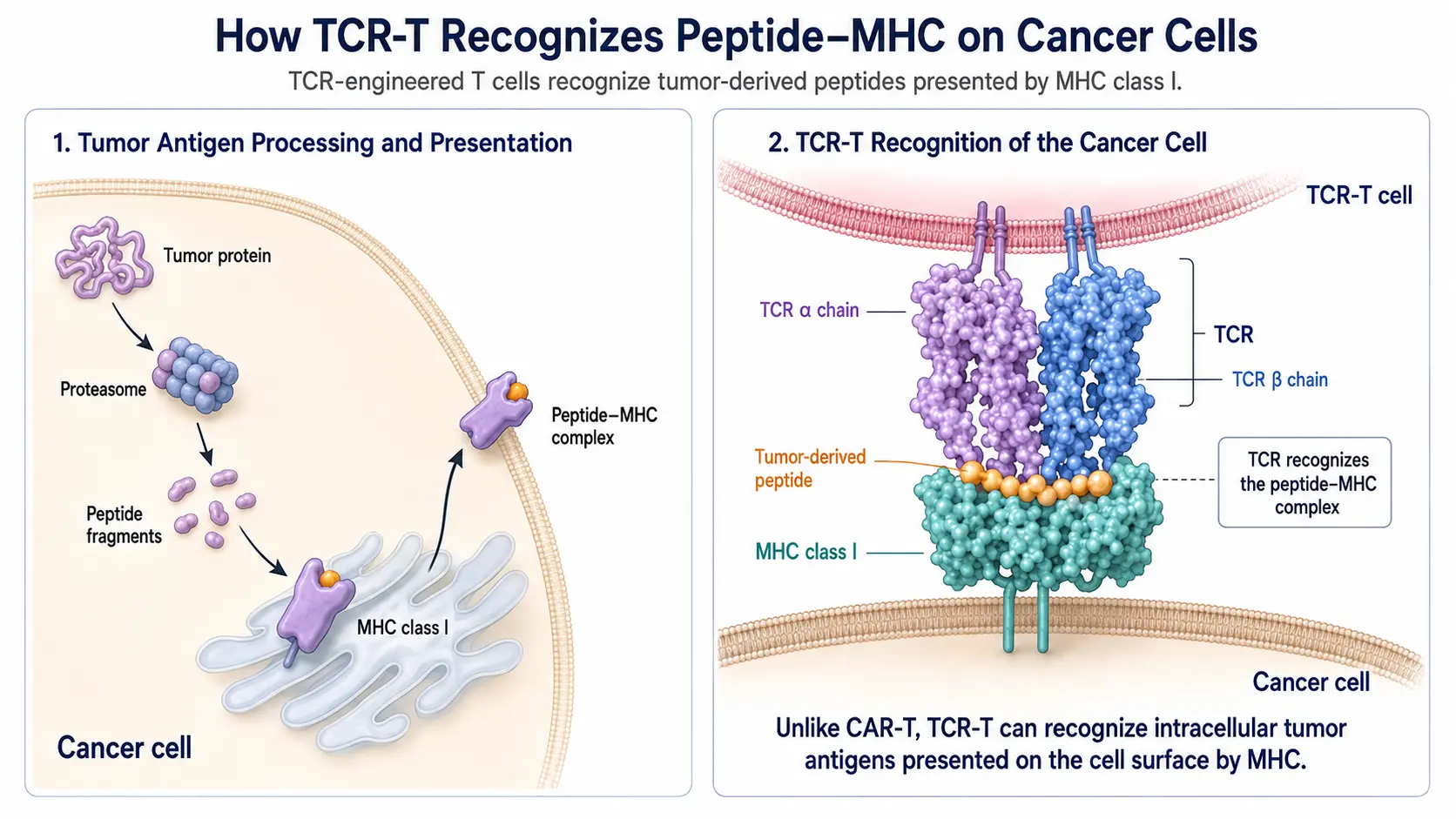
TCR-T, by contrast, uses the natural T-cell receptor to recognize a peptide-HLA complex, also known as a peptide-MHC complex, presented on the cell surface by HLA molecules—primarily MHC class I.
People often say that “TCRs recognize peptides,” but a more precise description is:
A TCR recognizes the peptide-HLA—or peptide-MHC—complex, not a free peptide by itself.
This distinction gives TCR-T and CAR-T fundamentally different therapeutic possibilities.
| Category | CAR-T | TCR-T |
|---|---|---|
| Recognition mechanism | Cell-surface antigen | Peptide-HLA complex derived from intracellular antigens |
| Can recognize intracellular proteins | No | Yes |
| Main therapeutic potential | Hematologic cancers | Solid tumors |
| HLA restriction | No | Yes |
| Number of potential targets | Relatively limited | Significantly broader |
| Commercial maturity | High | Moderate and rapidly developing |
CAR-T has achieved remarkable success in hematologic cancers, but it has not yet replicated the same results in solid tumors.
Several factors contribute to this challenge:
Meanwhile, approximately 80–90% of human proteins are located inside cells.
CAR-T cells have almost no access to these intracellular proteins. However, cells continuously break down intracellular proteins into peptides and present them on the cell surface through HLA molecules.
Therefore, if researchers can develop a TCR that recognizes the corresponding peptide-HLA complex, it may become possible to target cancer-associated proteins originating from inside the cell. This significantly expands the range of potential therapeutic targets—and represents the most important value of TCR-T.
This is the greatest advantage of TCR-T.
By leveraging the body’s natural MHC antigen-presentation system, researchers can engineer TCRs that recognize specific peptides derived from tumor-associated intracellular proteins, allowing T cells to identify and attack selected cancer cells.
Some of the most actively studied targets include:
Many cancers are driven by abnormal or mutated intracellular proteins. TCR-T, therefore, provides more possibilities than CAR-T.
Many current TCR-T clinical studies focus on cancers such as:
TCR-T can recognize intracellular antigens presented by HLA molecules. Because many important solid-tumor antigens originate inside the cell, TCR-T may have greater potential in solid tumors than CAR-T, which is limited to cell-surface antigens.
CAR-T can only recognize proteins expressed on the cancer cell surface, which limits the number of suitable therapeutic targets.
TCR-T is different. As long as an intracellular protein is broken down into peptides and presented on the cell surface by HLA molecules, it may theoretically be possible to develop a corresponding TCR to recognize it.
This substantially expands the number of potential targets.
As cancer cells grow, they accumulate genetic mutations. Some of these mutations produce new peptides—known as neoantigens—that are not present in normal cells.
Because these antigens are highly specific to cancer cells and are rarely found in healthy tissues, they may offer strong tumor specificity. Neoantigens have therefore become an important direction for personalized TCR-T development, particularly in cancers such as melanoma and lung cancer.
Some mutations are essential to the survival and growth of cancer cells. Examples include KRAS, TP53, BRAF, and EGFR. If peptides derived from these mutated proteins can be presented by HLA molecules, they may become potential targets for TCR-T therapy.
Some cancers are driven by viral infections, including HPV-associated cervical and head and neck cancers, EBV-associated nasopharyngeal cancer and certain lymphomas, and HBV- or HCV-associated liver cancer.
Because viral proteins are foreign antigens that do not normally exist in the human body, they can be highly immunogenic and may present a lower risk of damaging normal tissues. Viral antigens have therefore become another important focus of TCR-T clinical development.
HLA restriction is one of the greatest limitations of TCR-T—and one of its most important commercialization challenges.
A TCR-T product recognizes a specific combination of a peptide and an HLA molecule.
Different patients have different HLA types. For example, a TCR designed for HLA-A*02:01 can only be used in patients who carry that specific HLA type. If a patient has a different HLA type, the therapy cannot be used—even if the tumor expresses the same antigen.
This means that multiple HLA-specific versions of a TCR may need to be developed for the same target. Compared with CAR-T, the addressable market for each TCR-T product can therefore become more fragmented, increasing the complexity of product development and global commercialization.
Because TCRs can recognize peptides derived from the body’s own proteins, they may cause serious adverse effects if they recognize the intended antigen in normal tissues or cross-react with similar peptides derived from other proteins.
These risks can take two different forms:
Historically, some clinical trials have been terminated because of severe adverse events, including cardiac and neurological toxicities. Improving TCR specificity and conducting rigorous safety screening are therefore critical priorities in TCR-T development.
Some cancer cells evade immune recognition by reducing or losing HLA class I expression.
Once the relevant HLA molecule is no longer expressed, the TCR-T cell cannot recognize the cancer cell—even if the target antigen is still present. This represents a common immune-escape mechanism in many solid tumors.
Most TCR-T therapies currently use an autologous manufacturing model and therefore face many of the same challenges as CAR-T:
In other words, like CAR-T, the current TCR-T manufacturing model cannot easily achieve the economies of scale associated with conventional pharmaceutical production.
If you would like to learn more about the challenges of personalized cell therapy manufacturing, you can read this article on CAR-T manufacturing.
 ShaoChi CHENG
Unlike hematologic cancers, solid tumors are surrounded by a highly complex tumor microenvironment (TME).
The TME consists not only of cancer cells but also immune cells, fibroblasts, blood vessels, signaling molecules, and cytokines. Together, they create an immunosuppressive ecosystem that helps the tumor escape immune attacks.
Even if a TCR-T cell successfully recognizes its target peptide-HLA complex, it may still lose its activity—or fail to enter the tumor—because of the surrounding microenvironment.
Common immunosuppressive mechanisms include:
In other words:
TCR-T must do more than find the cancer cell—it must also break through the defensive fortress built around the tumor.
In 2024, the FDA approved Tecelra (afamitresgene autoleucel), developed by Adaptimmune, making it the world’s first approved TCR-T therapy.
Several other companies are also actively advancing TCR-T programs through clinical development:
| Company | Target | Main Cancer Focus |
|---|---|---|
| Adaptimmune | MAGE-A4 | Synovial sarcoma, ovarian cancer |
| Immatics | PRAME | Melanoma, lung cancer |
| TScan Therapeutics | KRAS, HPV | Multiple solid tumors |
| Medigene | Multiple TCR targets | Multiple solid tumors |
The approval of Tecelra marked an important milestone, signaling that TCR-T had officially moved beyond the research stage and entered commercialization.
As more biopharmaceutical companies invest in TCR-T development, I sincerely hope that more TCR-T therapies will reach the market and benefit a more patients.
The success of CAR-T has proven that cell therapy can transform cancer treatment. At the same time, it has revealed an important limitation:
The suitable cell-surface antigens that can serve as therapeutic targets are relatively limited.
TCR-T seeks to overcome this limitation by leveraging the body’s natural antigen-presentation system. It expands the target space from proteins on the cell surface to proteins inside the cell, significantly increasing the range of tumor antigens that can potentially be attacked—especially in solid tumors.
However, every technological breakthrough also creates new commercial challenges.
Compared with CAR-T, TCR-T must address market segmentation caused by HLA restriction, more complex patient screening, and the high costs and supply chain pressures associated with autologous cell manufacturing.
Whether TCR-T can become a mainstream treatment will depend not only on clinical efficacy, but also on whether manufacturing technologies, reimbursement systems, and business models can mature alongside the science.
Given the diversity of cancer, I do not believe that the future cell therapy market will be dominated by a single technology. Instead, it is more likely to develop into an ecosystem in which multiple platforms coexist:
The real question is not which technology will replace the others. It is how each platform can deliver its greatest value in different cancer types and clinical settings where it is best suited.